 Anthony
Buying Google Reviews Is Illegal Under a 2024 FTC Rule
You're stuck at 4.6 stars, the shop down the street shows 4.9, and an email lands offering 50 five star Google reviews for less than a tank of gas. So you wonder, can you buy Google reviews, and is it illegal? Yes, it's illegal in the United States. A Federal Trade Commission rule in force since October 2024 bans buying fake reviews, and the FTC says a violation can cost up to $53,088. Google also deletes the reviews and can put a warning on your profile that tells shoppers fake reviews were removed.
What You'll Learn
Know This Going In
- The FTC's Consumer Reviews and Testimonials Rule, 16 CFR Part 465, bans writing, selling and buying fake reviews.
- A business that buys reviews it knew or should have known were fake breaks the rule.
- The FTC put civil penalties at up to $53,088 per violation in its December 2025 warning letters.
- Google's own policy bans paid reviews, reviews from staff, and reviews from your marketing company.
- Google can freeze new reviews, hide your old ones and show a fake review warning on your profile.
- Asking every customer for a review is still legal and still works.
What the FTC Rule Actually Bans
The FTC voted 5 to 0 on August 14, 2024 to approve a final rule on fake reviews and testimonials (FTC). It took effect on October 21, 2024, 60 days after it ran in the Federal Register.
Section 465.2 is the part about fake reviews. It splits the people involved into three groups (16 CFR 465.2).
| Who | What the rule bans | Does the business have to know? |
|---|---|---|
| The writer or seller | Writing, creating or selling a review that lies about who wrote it or what happened | No. Selling a fake is enough |
| The business that buys | Buying reviews that lie about the reviewer or the experience | Yes, knew or should have known |
| The business that asks insiders | Getting owners, managers, staff or their families to post reviews that lie | Yes, knew or should have known |
A fake review here means one that misstates whether the reviewer exists, whether they used the business, or what their experience was. A real customer's real review is never the problem.
The rule goes past outright fakes. The FTC's summary lists five more bans (FTC).
- Paying for reviews on the condition that they say something good, or something bad
- Insider reviews that don't clearly disclose the link to the business
- A review site you control that pretends to be independent
- Threats, intimidation or false accusations used to get a review taken down
- Buying fake followers or views for business use
Knew or Should Have Known Is Where Owners Get Caught
Most owners who buy reviews tell themselves the seller uses real people. The rule doesn't let that excuse stand if the signs were there.
The FTC says a business has no general duty to check every review. It also lists red flags that show a business should have known. Reviews posted right after a purchase, a big pile of reviews in a short time, and reviews that name the wrong product all count (FTC Q&A).
Now think about how a review package works. You pay. Fifty strangers who never walked in your door post five stars over two weeks. Every one of those red flags is built into the product. Paying for reviews from people you've never served is about as clear a case of "should have known" as exists.
The sellers aren't safe either. The FTC says review brokers, agencies, PR firms and reputation managers can all be liable for writing or selling fake reviews (FTC Q&A). There's no small business exemption anywhere in that guidance.
What It Can Cost You
The FTC says violations can bring civil penalties of up to $53,088 per violation. It put that figure in its December 22, 2025 release, when it warned 10 companies about possible violations of the rule (FTC). The FTC said the letters were not findings that anyone broke the law. They were a warning shot.
How the FTC would count violations in a review case isn't spelled out in its Q&A. So treat the math below as a worked example of the ceiling, not a bill anyone has received.
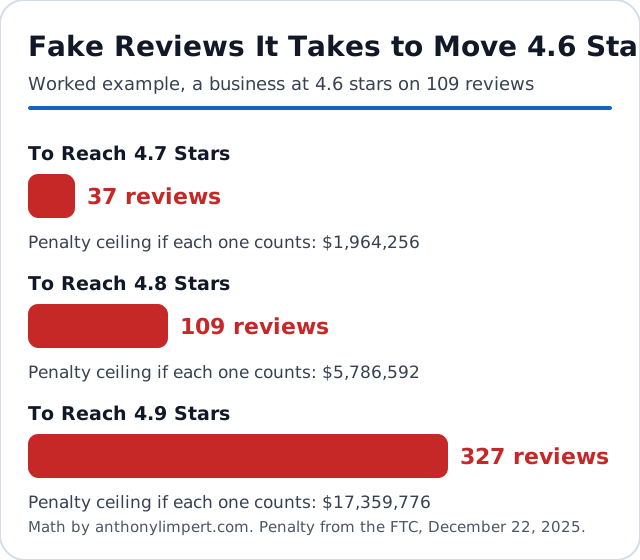
Picture a business at 4.6 stars on 109 reviews. To move its average, it needs a lot of fake five star reviews, far more than most owners guess.
| Goal | Fake 5 star reviews needed | Ceiling if each one counts as one violation |
|---|---|---|
| 4.7 stars | 37 | $1,964,256 |
| 4.8 stars | 109 | $5,786,592 |
| 4.9 stars | 327 | $17,359,776 |
The jump to 4.8 takes as many fake reviews as the business earned in its whole life. That's the part sellers leave out. A small package barely moves a real rating, and a big one is the sudden burst the FTC names as a red flag.
States have gone after this too, long before the FTC rule. In September 2013, New York's attorney general settled with 19 companies over fake online reviews. The penalties topped $350,000, and single fines ran from $2,500 to almost $100,000 (MarTech).
What Google Does When It Finds Bought Reviews
You don't need a federal case to lose. Google's policy on fake engagement bans reviews that were paid for, in cash or in kind (Google Maps contribution policy). The same policy bans reviews from people with a conflict of interest. That covers current and former employees, and anyone with a contract or consulting tie to you, like your marketing company.
When Google finds fake reviews, it removes them. It can also restrict the whole profile (Google Business Profile Help).
- The profile can't get new reviews or ratings for a set period.
- Existing reviews and ratings can be hidden for a set period.
- The profile shows a warning that tells shoppers fake reviews were removed.
Google says it emails the owner before it applies a restriction, and there's an appeal form. It doesn't publish how long a restriction lasts.
Think about what the third one does. A customer looking for you sees a notice that you got caught. That's worse than a 4.6 rating ever was. The real reviews you earned can vanish for a while too, which is the opposite of what you paid for.
If your reviews already dropped and you don't know why, start with why Google reviews disappear. Filters catch real reviews too, so a drop doesn't always mean a penalty.
What Is Still Legal
The rule targets fakes and pressure, not asking. Section 465.2 carves out reviews that come from a general request to customers to share their experience (16 CFR 465.2). So these are fine.
- Asking every customer for a review, in person, by text or by email
- A Google review link or QR code on a receipt, a card or a sign
- A family member who really used your business posting a review, if they clearly say they're related. The FTC's Q&A gives that exact example.
- Replying to every review, good and bad
Watch the line on rewards. The FTC rule only bans rewards tied to a positive or negative review. Google bans rewards for reviews, period. Google's rule is the stricter one, so it's the one you live by. The full side by side is in how to get more Google reviews.
Is Faking Google Reviews Illegal?
Yes. Writing or creating a review that lies about who wrote it or what happened is banned under Section 465.2(a). That applies with no proof of knowledge needed, since the writer always knows. It covers the owner who writes reviews from a second account, too.
Is Selling Google Review Cards Legal?
Yes, in general. A tap card or QR card just opens your review page. That's a general request to customers, and the rule allows it. It turns into a problem only if the card comes with a reward, or if staff hand it only to customers who seem happy. Google bans that kind of picking.
What If Someone Posts Fake Reviews About Your Business?
The rule bans writing and selling fake reviews no matter who pays for them, and that includes one star attacks. Save screenshots with dates, then report them to Google. The steps are in how to remove bad Google reviews.
Can You Pay Someone to Remove Bad Reviews?
Not to make true ones go away. The FTC says paying to change or remove a truthful negative review may break the FTC Act (FTC Q&A). Google's policy also bans rewards for changing or removing a negative review. A calm public reply does more. See how to respond to Google reviews for wording.
Do Bought Reviews Even Work?
Rarely for long. Google removes the fake ones it finds, and a burst of five stars from strangers is a red flag the FTC names by name. The worked example above shows how many it takes to move a real rating. Each one is a risk, and the payoff is a tenth of a star.
Your Checklist This Week
- Delete any review seller emails and don't reply to them
- Check your profile for a fake review warning or a missing review count
- Remove any review you or your staff posted about your own business
- Make your Google review link and add it to receipts and texts
- Ask every customer the day the job ends, with no reward attached
Got an agency that once "handled" your reviews and you're not sure what it did? Book a strategy call and Anthony will go over the profile with you.
Connected Guides
- How to get more Google reviews without paying for one
- How to remove bad Google reviews
- Why Google reviews are not showing up
- How to respond to Google reviews
Official Sources
- FTC, final rule banning fake reviews and testimonials, August 14, 2024
- FTC, warns 10 companies about possible violations of the Consumer Review Rule, December 22, 2025
- FTC, Consumer Reviews and Testimonials Rule questions and answers
- 16 CFR 465.2, fake or false consumer reviews, Cornell Legal Information Institute
- Google Business Profile Help, Business Profile restrictions for policy violations
- Google Maps user contributed content policy, fake engagement and conflict of interest
- MarTech, New York attorney general settles with 19 companies in fake review crackdown, September 23, 2013
Want my new posts near the top when you search? Pick Anthony Limpert as a preferred source on Google and Google shows them to you more often in Top Stories.