 Anthony
 Call Tracking For Local Businesses: What To Track And Why
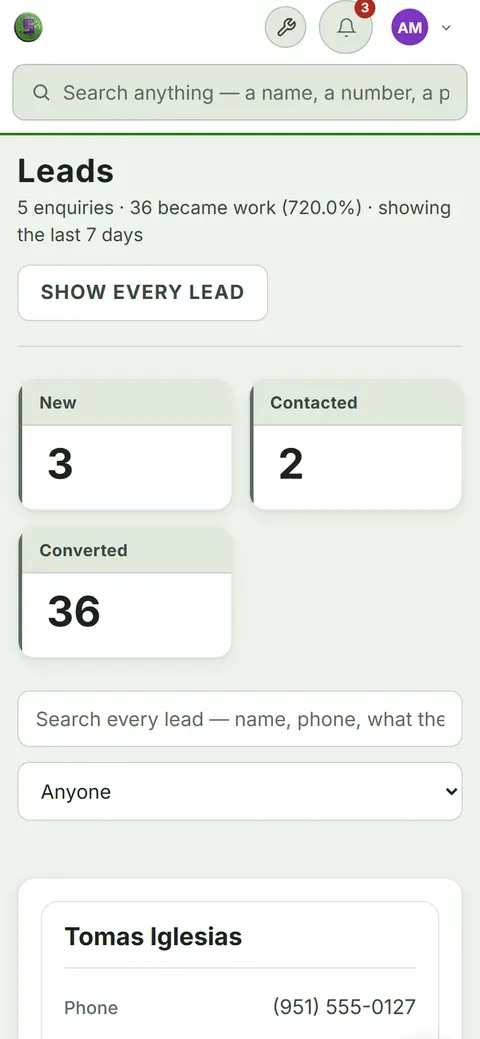
Track every inbound call by source, and listen to a sample of them. At minimum you need to know how many calls came in, which channel sent them, how many were answered, and how many turned into jobs. That one habit tells you where your money works and where it leaks, and it usually shows you losing business you did not know you were losing.
Most local businesses I talk to answer the question "where do your customers come from?" with "word of mouth and Google, I think." They are guessing. Phone calls are the main way service customers reach a local business, and almost nobody measures them.
Key points
- Use a different tracking number for each major source: website, Google Business Profile, ads, directories.
- Track answered, missed and first time callers, not just total calls.
- Record the calls, with the right notice, so you can hear what customers actually ask for.
- Missed calls are the biggest hidden cost. Count them every week.
- Do not swap the number on your Google Business Profile carelessly. Keep your real number as primary there.
- Tie calls to booked jobs. A call is not a customer until it books.
Why Calls Are The Number That Matters
For a plumber, a locksmith, a mobile mechanic or a roofer, the phone is the sale. Clicks and impressions are interesting, but a click that never calls is not money.
We have tracked every Supercanic call in CallRail since September 2024. That data changed how we run the business. We learned which hours we miss calls, which pages get the most first time callers and which keywords bring serious jobs and which bring price shoppers. None of that shows up in Google Analytics alone.
What Call Tracking Actually Is
Call tracking gives you extra phone numbers that all ring the same line. Each number is tied to a source. When a call comes in on the "Google Business Profile" number, you know it came from there.
A tool like CallRail can also do dynamic number insertion. That swaps the number shown on your website depending on how the visitor arrived. A visitor from an ad sees one number, a visitor from organic search sees another. You see which keywords and pages drove each call.
You do not need a pile of numbers on day one. Start simple.
| Source | Tracking number? | Why |
|---|---|---|
| Website, all visitors | Yes, dynamic | Shows organic, ads and direct |
| Google Business Profile | Keep main number primary, add tracking as secondary | Protects consistency of your listing |
| Paid ads | Yes, its own number | Proves ads pay |
| Directories and print | One number each if you can | Shows if they work |
| Business cards, truck | Your real number | Keep it simple |
What To Track
Here is the short list I would set up first.
- Total calls by source. Which channel sends the most.
- Answered versus missed. A missed call from a new customer is a lost sale.
- First time callers. New business, not repeat customers.
- Call length. Very short calls are often wrong numbers or hang ups. Long calls tend to be real jobs.
- Time of day. Shows when you need someone on the phone.
- Booked jobs from calls. The only number that pays your bills.
Everything else is nice to have. Do not drown in the dashboard.
The Missed Call Problem
This is the one that shocks owners. When we first look at a business, the missed call rate is often much higher than they think. Calls come in while the owner is under a car, on a roof or at lunch. The customer calls the next business on the list.
Fix it in layers.
- Set up a text back for missed calls, such as "Sorry we missed you, what do you need?"
- Add voicemail with a short, clear greeting.
- Use call forwarding to a second person during busy hours.
- Look at your missed calls at the same time each week and call people back.
For a shop, this alone can be worth more than any ad. Missed calls are customers who already wanted you.
Listen To Some Calls
Recording calls is where the real insight lives. You hear what customers call about, what they ask, what words they use for your service, what they object to. Those words make better headlines and ad copy than anything you would guess.
Two cautions. Tell callers that calls may be recorded, since laws vary by state and California requires all party consent. And protect those recordings like customer data, because that is what they are. Ask a lawyer about your state.
Setup Mistakes That Wreck Your Data
I see these a lot.
- Replacing your main number everywhere. Your name, address and phone number need to stay consistent across the web. Keep your real number as the primary on your Google Business Profile and use tracking as an extra.
- No tracking on the website at all. Then every call looks like "direct."
- Counting your own calls. Staff testing the number inflate the data. Exclude them.
- Forgetting forms and texts. Calls are not the only lead. Track form fills and texts too.
- Never connecting calls to jobs. If a call books a job, mark it. Otherwise you cannot know your real cost per customer.
How To Use The Numbers
Once you have a month of data, ask three questions.
- Which source gives the most first time callers?
- Which source gives the most booked jobs?
- Which source costs the most for each booked job?
Move money toward the ones that win. If ads bring a lot of calls but few booked jobs, the problem may be the keywords or the landing page. If your Google Business Profile brings steady calls for free, protect it with reviews and posts.
This is also how you find out if a marketing agency is working. Ask for calls and booked jobs, not impressions. If you want to see how that looks in practice, work with me on a call and I will show you real tracking reports.
A Simple Weekly Routine
Ten minutes every Monday.
- Open your call report for last week.
- Note total calls, answered, missed and first time callers.
- Call back every missed number from a new caller.
- Listen to three recordings.
- Write down one thing to change.
That routine is worth more than any monthly report you pay for. Pair it with a site that makes calling easy. If it does not, start with why most small business websites don't get calls.
Questions
Is call tracking legal?
Yes, but recording calls has legal rules that vary by state. Some states need consent from everyone on the call. Play a short notice at the start and check with a lawyer for your state.
Will call tracking hurt my Google Business Profile?
It can if you replace your main number. Keep your real number as primary on the profile and add the tracking number as a secondary if you want to measure it.
How much does call tracking cost?
Tools like CallRail charge a monthly fee that grows with the number of lines and call minutes. Check current pricing on the provider's site. For most small businesses it costs far less than one lost job.
Do I need call tracking if I only get a few calls a week?
Yes, probably even more. When volume is low, every missed call hurts. Tracking tells you where the few calls come from so you can protect them.