 Anthony
 How To Write Headlines That Sell
A headline that sells does three things in a few words. It tells the right person this is for them, it names a result they want, and it makes them read the next line. Skip cleverness. Say what you do, for whom, and what they get. If a stranger can read your headline and repeat back what you sell, it works. If they cannot, rewrite it.
I write and review a lot of copy. I run Clickflame, an agency, and I build sites for trades, shops and local businesses. The same mistake shows up on most homepages: the headline is about the business, not the customer. "Welcome to ABC Services" sells nothing. Fixing the headline is the highest return edit on a page.
Key points
- Lead with the customer's problem or the result, not your company name.
- Be specific. Numbers, places and timeframes beat adjectives.
- Write in plain words a 12 year old would understand.
- Test five versions. The first one you write is rarely the best.
- The headline and the first line under it must work together.
Why Headlines Matter So Much
Most visitors read the headline and not much else. If it does not grab them, they leave. If it does, they scroll. That makes the headline a gate.
Think about where headlines live: your homepage, service pages, ads, emails, social posts, even Google titles. They all do the same job. They answer "is this for me?" before the reader decides to spend another second on you.
Worst Problem First: The Vague Headline
I look at lists of local business sites all the time. These are the headlines I see again and again.
- "Quality Service You Can Trust"
- "Your Satisfaction Is Our Priority"
- "Welcome To Our Website"
- "Excellence In Everything We Do"
Not one of those tells you what the business does. You could paste them on a plumber, a dentist or a florist. A headline that fits every business fits none.
Compare with real ones from our own sites:
- On Supercanic: "Auto Repair Shop and Mobile Mechanic in San Jacinto, Hemet and Riverside County." That names what, and where.
- On Your Shop Desk: "A CRM That Fits Like Your Best Pair of Work Boots." That uses an image the reader gets right away.
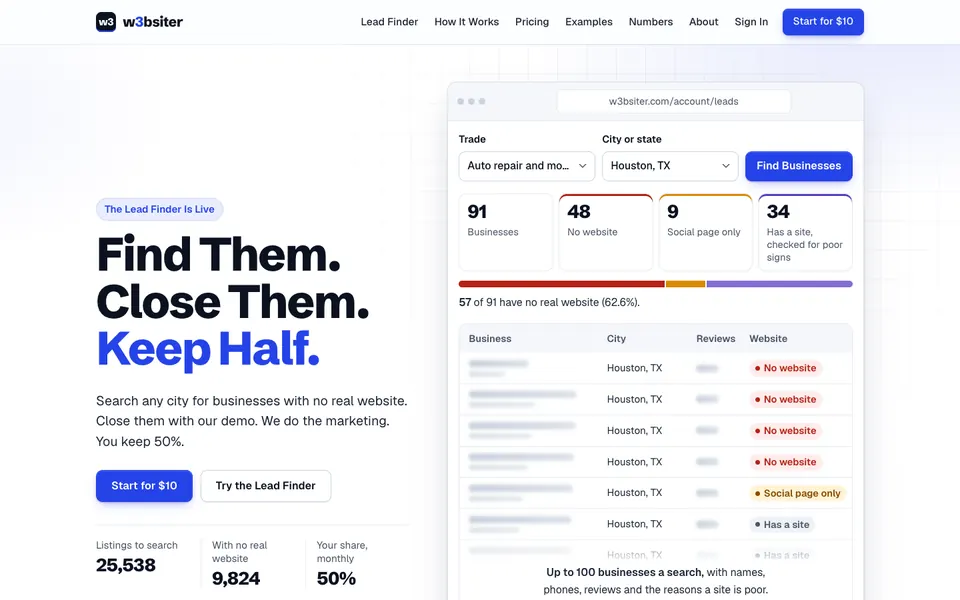
- On w3bsiter: "Find Them. Close Them. Keep Half." Three short commands that spell out the whole offer.
Notice how different they are. The common thread is that each one is concrete, and each one tells a specific reader what to expect.
A Simple Formula
Use this one when you are stuck:
Who it is for + what they get + how fast or how easy
Examples:
- "Same day mobile mechanic for Riverside County drivers."
- "A website for your shop in weeks, not months."
- "Roof leak? A real person answers, day or night."
You do not need all three parts every time. Two is enough. Three is a bonus.
Headline Types That Work
| Type | Formula | Example |
|---|---|---|
| Result | What they get | "More calls from the people already searching for you" |
| Problem | Name the pain | "Missing calls costs you jobs" |
| Question | Ask what they are thinking | "Is your website losing you customers?" |
| How to | Teach one thing | "How to get more Google reviews without begging" |
| Number | A list or fact | "7 things to check before you pay for a new site" |
| Local | Name the place | "Mobile mechanic in San Jacinto" |
| Command | Tell them what to do | "Get a price before we start" |
Pick the type that fits where the reader is. A cold visitor needs a clear promise. Someone who already knows you can handle a little personality.
Use Real Numbers
Numbers get attention because they feel like proof. They also make your claim concrete. Compare:
- "We have lots of reviews."
- "299 Google reviews."
The second can be checked. If you have a number that is true and impressive, use it. If it is small, use something else. Never invent one. Your customers can tell, and a made up number is worse than none.
Good numbers to use, when true: years in business, jobs done, review count and rating, response time, warranty terms, a posted price.
Cut The Fluff
Take any headline you wrote and run this check.
- Delete adjectives. "Premier", "world class", "innovative" prove nothing.
- Cut the first three words if they are "Welcome to" or "We are".
- Switch to "you". Make the customer the subject.
- Shorten it. If it runs two lines on a phone, trim it.
- Read it out loud. If you would not say it to someone at a counter, change it.
Short is not the same as good. A headline can be five words and still say nothing. Cut for clarity, not for the sake of it.
Match The Headline To The Page
Every page needs one job and a headline that fits it. Here is how I think about it:
- Homepage: Who you are for and what you do.
- Service page: The specific service and the area.
- Landing page for ads: The same words as the ad, so the visitor knows they landed in the right place.
- Blog post: The question the reader typed into Google.
- Email subject: One idea, plain, under about 50 characters.
The big mistake with ads is a mismatch. The ad says "Brake repair from $150" and the page says "Welcome". Visitors bounce. I cover that in landing page optimization tips.
Subheads Finish The Job
Your headline opens the door. The line right under it closes the deal. Use it to add the one thing the headline could not fit: proof, a price, a location or a promise.
A good pair looks like this:
Same Day Mobile Mechanic Call by 2pm and we come to your driveway. You get a price before we start.
The headline is the promise. The subhead explains how. Then a button right below.
Test Before You Commit
You do not need software. You need a list.
- Write ten headlines in ten minutes. Most will be bad.
- Cross out anything vague.
- Pick three. Read them to someone who does not know your business.
- Ask them what you sell. If they get it wrong, the headline failed.
- Use the winner. Check your call and form numbers for a month.
If you run ads, you can test two versions at once. For a normal local site, change one thing and compare to the month before, keeping seasonality in mind.
Questions
How long should a headline be?
As long as it takes to be clear, and no longer. Many strong homepage headlines are between five and twelve words. On a phone, long headlines wrap into walls of text, so trim until it fits in two or three lines.
Should I put my business name in the headline?
Usually not on your own homepage. Your name is already in the logo and the browser tab. Use the headline space to say what you do and for whom. For brand new businesses with no name recognition, that is even more true.
Do clever headlines work better than plain ones?
Plain wins most of the time. Clever works when it is also clear, like a short punchy phrase with a plain subhead. If you have to choose between clever and clear, choose clear.
How often should I change my headline?
When you have a reason, such as a new offer, a better number or a clear sign it is not working. Do not change it weekly. Give any version at least a month so you can compare calls and form fills.
If you want your homepage headline and first screen reworked, book a strategy call. I will rewrite it with you on the call.